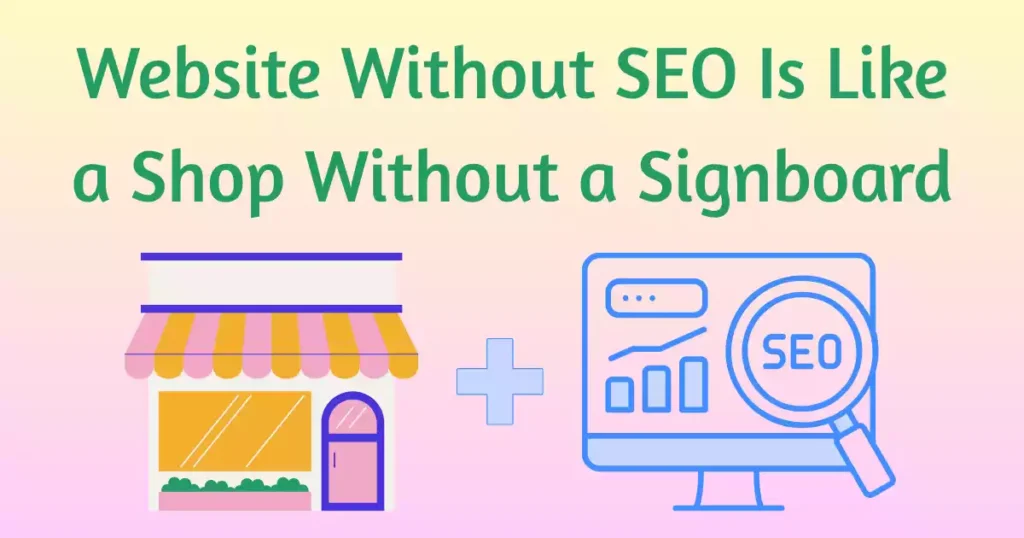
Website Without SEO Is Like a Shop Without a Signboard
Imagine opening a beautiful shop in a busy marketplace. The interior is perfect, the products are excellent, and the service is outstanding.
But there is one problem.
There is no signboard outside the shop.
People walk past the store every day, but they do not know what it sells, why they should enter, or even that it exists. This is exactly what happens when businesses build a website but ignore Search Engine Optimization.
A website without SEO may look great, but it remains invisible to the people who are searching for the services you offer. In the digital world, SEO is your signboard, your location marker, and your customer attraction system.
Without it, even the best website struggles to be discovered.
Let me explain you it in detail.
Does a website need SEO?
The simple answer is YES.
Without SEO, a website is like a shop hidden in a remote alley with no directions.
SEO ensures that search engines understand your website and present it to people searching for relevant information. It also helps businesses compete in crowded digital markets where visibility determines success.
In today’s competitive online environment, SEO is not optional. It is essential.
What are the 4 types of SEO?
- On Page SEO: Optimizing content, keywords, headings, and internal links within the website.
- Off Page SEO: Building authority through backlinks, brand mentions, and external signals.
- Technical SEO: Improving website speed, mobile friendliness, indexing, and crawlability.
- Local SEO: Optimizing online presence for location based searches.
Together, these strategies help websites perform better in search engine rankings.
What are the 4 pillars of SEO?
The 4 pillars of SEO represent the foundation of a strong optimization strategy.
It include:
- Technical Optimization: Ensuring search engines can properly crawl and index the website.
- Content Quality: Providing valuable, informative, and relevant content for users.
- Authority Building: Earning trust through backlinks and brand credibility.
- User Experience: Creating a website that is fast, mobile friendly, and easy to navigate.
What Is the 80 20 Rule of SEO?
The 80 20 rule of SEO is based on the principle that a small number of actions generate the majority of results.
In SEO, this means that roughly 20 percent of optimization efforts often produce 80 percent of traffic growth.
Examples:
- Targeting high intent keywords
- Creating valuable content
- Optimizing page speed
- Building quality backlinks
READ ALSO: Difference Between SEO and SEM in Digital Marketing
What if the website works without SEO?
When a website is created without search engine optimization, several problems occur.
- First, search engines struggle to understand what the website is about. Without proper keyword structure, optimized content, and technical signals, Google cannot easily categorize the website.
- Second, the website may not appear in search results when users search for relevant services or information.
- Third, potential customers may never discover the website organically.
As a result, the website becomes dependent on paid advertising or direct links instead of building long term organic visibility. This is why SEO is considered the foundation of online discoverability.
Key reasons SEO is your digital signboard
When SEO is implemented correctly, it helps:
- Improve search engine rankings
- Increase website visibility
- Attract targeted audiences
- Build credibility and trust
- Generate consistent organic traffic
Instead of waiting for customers to accidentally find your website, SEO actively connects your business with people searching for your services.
Redesign Website Without Losing SEO
If you do your site redesign incorrectly, it can hurt your search rankings and reduce organic traffic.
To prevent this, businesses should focus on several key steps:
- Preserve existing URL structures whenever possible.
- Maintain optimized content and keyword relevance during the redesign.
- Implement proper redirects if URLs change.
- Ensure technical SEO elements such as meta tags, schema, and page speed remain optimized.
When handled properly, a redesign can improve both user experience and search engine performance.
Migrate Website Without Losing SEO
Another common challenge occurs when businesses change hosting platforms or move to a different website system.
Website migration involves moving content, URLs, and technical structure from one platform to another.
Without proper planning, migrations can lead to:
- Loss of indexed pages
- Broken links
- Lower search rankings
- Reduced organic traffic
To protect SEO performance during migration, businesses should:
- Create a detailed migration plan
- Implement 301 redirects for changed URLs
- Monitor Google Search Console for errors
- Reindex pages properly after migration
A well managed migration ensures that SEO authority remains intact.
Local SEO Help
For businesses targeting nearby customers, local SEO is one of the most powerful strategies. Local SEO ensures that businesses appear when people search for services within their geographic area.
For example, when someone searches for a service with location keywords, search engines prioritize relevant businesses nearby.
Effective local SEO includes:
- Optimizing Google Business Profile
- Adding location based keywords
- Building local citations and directories
- Encouraging customer reviews
- Creating location specific content
These steps help businesses appear in local search results and attract nearby customers.
READ ALSO: What to do to get Google’s attention to your website?
A Simple Comparison
| No SEO | With SEO |
|---|---|
| Lonely website, no incoming traffic | Visitors find you organically |
| Ads only bring one-time clicks | Evergreen content drives ongoing traffic |
| Hidden in search engine results | Visible on page one for key terms |
Organic Traffic
One of the most valuable outcomes of SEO is organic traffic.
Organic traffic refers to visitors who find your website through search engine results without paid advertisements.
These visitors are highly valuable because they are actively searching for information, services, or products related to your business.
Benefits of organic traffic include:
- Higher trust and credibility
- Better long term sustainability
- Reduced marketing costs
- Consistent visitor growth
Businesses that prioritize organic traffic build stronger digital foundations.
How We Can Help
At Digital Marketing – Grow Online (DMGO) in Thorrur, Telangana, we treat SEO like a strategic signboard:
- We audit your site to identify gaps and quick wins.
- We optimize your content, technical setup, and local presence.
- We build a content schedule that brings consistent traffic.
- We track results and adjust – your site gets stronger over time.
READ ALSO: 10 biggest SEO myths busted
Closing Thoughts
A website is an investment—make sure it’s seen. Without SEO, it’s like shouting into an empty room. But a site optimized for search becomes your 24/7 salesperson—working even while you sleep.
👉 Want to hang a digital signboard and attract customers online? Contact Us!
READ MORE: Digital Marketing vs Traditional Marketing
Well said! Even the best-designed website is useless if no one can find it. SEO is the bridge that connects businesses with people who are actively searching for what you’re offering.
Without SEO, a website just sits silently on the internet. With SEO, it becomes discoverable, searchable, and valuable for the right people.
So true yaar. Loved how simply you explained this 👍
This made total sense while reading. SEO really can’t be ignored anymore.
Very well said. This example makes it crystal clear that SEO is the identity of a website, just like a signboard is the identity of a shop. Without it, customers simply won’t find you.
This post clearly shows why SEO should never be ignored. Visibility is everything in the digital world.
Loved this thought. SEO really works like a guide that leads customers straight to your website.
A powerful comparison. A website without SEO is like a shop in a hidden street with no board.
Perfectly explained in simple words. SEO is the foundation of online success.
This is so relatable for small business owners. SEO is what brings real visitors, not just a beautiful design.
Very true analogy. Without SEO, even a well-built website stays invisible. Just like a shop needs a signboard, a website needs search visibility.
Great insight. This post clearly shows why SEO should be the first priority for any new website.
I completely agree. Without SEO, even the best website remains hidden. This analogy makes the concept very clear.
This comparison makes everything clear in one line. Without SEO, your website is practically invisible in the crowded online market.
Very well explained. Many startups focus only on design, but traffic and conversions come only when SEO is done right.
So true. A website without SEO is just a digital brochure, but with SEO it becomes a powerful lead-generating machine.
This analogy is gold. It clearly shows why SEO is not optional but essential for any online business that wants real visibility and growth.
Very insightful. A well-optimized website works like a 24/7 salesman, while a non-SEO site just stays invisible.
This post explains digital marketing reality so well. SEO is not a luxury anymore, it’s a necessity.
Excellent comparison. No matter how good your product is, if people can’t find you online, sales will always suffer.
Simple words, deep meaning. SEO is what brings life to a website, just like a signboard brings customers to a shop.
I learned this the hard way. After implementing SEO, my website traffic increased steadily. Visibility is the real game.
This line should be printed everywhere: “Website without SEO is like a shop without a signboard.” So true for small business owners who depend on Google traffic.
Perfectly said. Many people spend money on websites but forget SEO, then wonder why no leads come. This analogy explains the real problem in a simple way.
Great explanation for beginners. This makes it easy to understand why SEO is a long-term investment, not an expense.
Absolutely! A website without SEO is like opening a shop in a jungle with no road signs. Visibility is everything in today’s digital world.
Such a simple yet powerful comparison. SEO truly acts like a direction board guiding customers straight to your business.
This post hits hard. I invested in website design but ignored SEO for months. After doing proper keyword optimization and content SEO, traffic finally started coming.
Loved this analogy. It perfectly explains why SEO is not optional anymore. A beautifully designed website is useless if people can’t find it on Google.
Very true! I built my website last year but got almost no traffic until I started SEO. Now I understand why SEO is like a signboard for a shop — without it, no one even knows you exist online.
Loved the analogy. It instantly makes you realize how invisible a website can be without proper SEO.
Such a powerful and true comparison. A website without SEO really is like opening a beautiful shop in a hidden lane with no signboard — no matter how good your products or content are, people simply won’t find you. This blog explains it in such a clear, relatable way that even non-technical readers can understand why SEO is not an option, but a necessity for real online visibility and growth.
I’ve struggled with website traffic until I focused on SEO. This post perfectly sums up why it’s essential.
SEO is often overlooked, but this post shows why it should be a priority. Thanks for the informative post!
The shop sign example helped me better understand the value of SEO. I’m excited to put these tips into practice!
clear-cut and educational. For websites, SEO acts as a beacon, making sure the right people see them.
Your online presence can be made or broken by SEO. I appreciate you sharing!
I appreciate the simple comparison you made. It’s so true that without SEO, potential customers just pass by without noticing.
Great post! SEO is definitely the backbone of online visibility. I believe every business should prioritize it from day one.
The importance of SEO for boosting traffic to a website is clearly shown by this blog. Even the greatest website may go unnoticed without it. I appreciate you sharing these thoughts.
I liked the comparison! Before I spent money on SEO for my site, I felt like a store without a sign. Now, the difference is very clear.
Very relatable, many businesses overlook this. Strong message in simple words.
Makes perfect sense. No SEO means no traffic.
This is exactly what many startups ignore.
SEO is the real signboard of the digital world. So true.
Straightforward and impactful. Great insight.
Very well explained. Every business owner should read this.
SEO truly decides whether your website survives or not.
I relate to this completely. My site had zero traffic.
Clear and practical explanation. Makes total sense.
Such a simple example but very powerful message.
Visibility matters more than just having a website.
This opened my eyes. I was ignoring SEO for months.
Completely agree. SEO is not optional anymore, it is basic necessity.
I learned this the hard way. Design is not equal to visibility.
The signboard example really explains SEO in the simplest way possible.
So true. A good looking website means nothing if no one can find it.
This analogy is perfect. I built a website but never focused on SEO. Now I understand why traffic is so low.
Clear, simple, and powerful message. I see so many businesses here in Canada that invest in websites but skip optimization. Big missed opportunity.
This analogy really hits home. I invested thousands into web design but ignored SEO. Big mistake. Thanks for breaking it down so clearly.
Straight to the point and practical. I used to think just having a website was enough. Now I realize ranking on Google is what actually brings business.
This makes so much sense. I launched my small ecommerce store last year and didn’t focus on SEO at all. Traffic was almost zero. Once I optimized properly, everything changed. A shop without a signboard is exactly how it felt.
Great reminder!
Clear, practical, and easy to understand.
I used to think social media was enough. Now I see why SEO matters long term.
I love how you explained visibility in such a relatable way. Great reminder for business owners.
Simple explanation but powerful message. SEO truly makes the difference.
I invested in design but skipped SEO. Now I understand why no one was finding my site.
This analogy makes so much sense. I had a website for a year with almost no traffic because I ignored SEO.
Very relatable content. I work with local businesses in Texas, and most of them think a website alone brings customers. This “shop without a signboard” example is something I’ll actually use with my clients now.
Absolutely! I made the same mistake a year ago. I invested in design but ignored SEO.
It make so much sense.
Loved how clearly this was explained. Design attracts, but SEO brings traffic. Both matter, but SEO comes first.
Online success starts with being found first.👍
Clear and straight to the point. SEO is the foundation, not an option.
Couldn’t agree more. Traffic doesn’t just happen. SEO makes the real difference.
SEO turns a website from static to strategic.
A stunning site means nothing if Google can’t see it.
Strong point. Design attracts, but SEO invites the world in.
Well said. Traffic does not happen by chance. Smart SEO is what turns clicks into real customers.
So true. Without SEO, a website is just sitting there waiting with no visitors walking in.
Loved the shop signboard example. SEO truly makes the difference between being seen and being ignored.
Absolutely true! Loved the simple comparison, makes perfect sense.
This makes so much sense.👍
Simple yet effective example, SEO is what actually brings customers to your digital door.
So true. A website alone isn’t enough. Without SEO, it’s almost invisible online.
Absolutely! SEO is an unbreakable part of online success. It’s just like Car(WEBSITE) without Petrol(SEO).👍
Totally agree with this!
Nice heading. Without SEO, a website simply sits online and no one knows it exists.
Clear and simple explanation. SEO is definitely the backbone of any website that wants real visitors.
Very well explained. SEO really acts like a signboard that brings people to your digital storefront.
A great example. This clearly shows why businesses should focus on search visibility from the start.
Short, clear, and impactful.
Well explained.
I agree completely.
Simple yet powerful explanation. This is something every website owner should read.
Exactly. Many business owners still underestimate how powerful SEO can be.
Loved the comparison. It instantly makes the importance of SEO easy to understand.
Clear and practical information. SEO really works like a website’s visibility engine.
This explains perfectly why many websites fail to attract traffic despite good design.
Absolutely! A website without SEO is really worthless.
Clear and practical insights.
Clear and simple explanation. Without SEO, even a good website cannot reach the right audience.
Perfectly explained.
Importance of SEO is very clear by this article.
Very informative. SEO is definitely the key factor that brings real traffic to a website.
Yes, it’s true, I was faced the situation. A website without SEO truly struggles to get noticed online.
عظیم مثال۔ SEO کے بغیر، ویب سائٹ گوگل پر درجہ بندی نہیں کرے گی۔
جناب آپ نے یہ واقعی بہترین تحقیق اور تجربے سے لکھا ہے۔
I really like this comparison. It’s very simple to understand.
I am also an SEO expert, and I agree 100% with your article. You have shared some really profound and insightful things that stem from your experience.
A simple, yet powerful idea. This is very helpful for newbies like me. Thanks for sharing your experience, Sampati Kumar.
Yeah, that’s true! I was also ignored seo while i was just started my e-commerce business. But my friend who told me exactly what you are explaining here and I followed it, now I’m happy with my business output.
Perfect!
Real SEO experience teaches you one thing, traffic grows when your website truly deserves to be found, not just when it exists.
Ignoring technical SEO is like building a shop with a locked door.
SEO is not a one-time task, it’s an ongoing investment that compounds over time.
Ranking on Google isn’t magic, it’s the result of aligning content with user intent.
Every successful website I’ve worked on had one thing in common, strong SEO fundamentals.
Real SEO starts where shortcuts end, with patience, data, and consistency.
Content alone doesn’t rank, strategic optimization is what makes it visible.
I’ve seen great businesses struggle online just because they underestimated SEO.
I’ve audited hundreds of sites, most don’t fail because of design, they fail because search engines can’t understand them.
After decades of experience in SEO, one truth stands clear, ranking isn’t luck, it’s structure, consistency, and intent.
Exactly! If your competitors are ranking and you’re not, SEO is the difference.
Ignoring SEO is like ignoring customers who are already searching for you.
Hoping for traffic without SEO is not strategy, it’s wishful thinking.
Exactly! No SEO means you’re choosing to stay invisible.
If Google can’t find you, your customers won’t either.
Absolutely! A beautiful website without SEO is just an expensive mistake.
If your website isn’t getting traffic, it’s not bad luck, it’s missing SEO.
Without SEO, your website is just another hidden page online.
Visibility is everything, SEO makes your website visible.
SEO is the bridge between your website and your audience.
No SEO means your website is lost in the digital crowd.
SEO is what turns a website into a discoverable brand.
A website without SEO is like a shop without direction.
Without SEO, even quality content stays unseen.
Without SEO, your website exists, but no one knows it.
A smart website always needs smart SEO to succeed.
SEO gives your website purpose and direction.
Without search visibility, your website is just floating online.
SEO turns a silent website into a powerful business tool.
A website without SEO is just a hidden opportunity.
Perfect! Design attracts, but SEO delivers visitors consistently.
SEO is the signboard that guides customers straight to your website.
It’s simple, no SEO means no traffic, no traffic means no business.
Without SEO, even the best website stays invisible to the right audience.
A beautiful website means nothing if no one can find it. SEO brings real visibility.