Difference Between SEO and SEM in Digital Marketing
In digital marketing, two terms dominate every strategy discussion: SEO and SEM.
Many business owners think they are the same.
But they are not.
Understanding the difference between SEO and SEM in digital marketing can completely change how you invest your marketing budget and how fast you grow online.
Let’s break it down step by step.
What is SEO and How Does It Work?
SEO stands for Search Engine Optimization.
It is the process of improving your website so that it ranks organically on search engines like Google, Bing or others, without paying for ads.
For an example, when you or someone searches on Google for:
- Best digital marketing agency
- Website builder in Hyderabad
- E-commerce SEO services
SEO helps your website appear in the unpaid results.
How does it work?
Search engines use algorithms to evaluate:
- Website quality
- Content relevance
- User experience
- Authority
- Technical structure
When your website aligns with these ranking factors, it earns higher visibility.
SEO works long term. It builds authority and compounds over time.
Types of SEO
- On-Page SEO: Optimizing content, keywords, meta tags, internal linking, and structure.
- Off-Page SEO: Building backlinks, brand mentions, authority signals.
- Technical SEO: Improving site speed, indexing, mobile-friendliness, schema, crawlability.
- Local SEO: Optimizing for geographic searches like “digital marketing agency in Hyderabad.”
Each type plays a critical role in overall ranking performance.
What Is the Process of SEO?
SEO is not random, it follows a structured system.
Step 1: Keyword Research
Identify what your target audience is searching for.
Step 2: Competitor Analysis
Step 3: Technical Optimization
Fix speed, structure, and indexing issues.
Step 4: Content Creation
Create high-quality, search-intent driven content.
Step 5: On-Page Optimization
Implement keywords naturally with semantic relevance.
Step 6: Link Building
Earn authority signals from relevant websites.
Step 7: Performance Tracking
Monitor rankings, traffic, conversions, and refine.
SEO is a process of consistency, not quick wins.
What Are the 4 Pillars of SEO?
- Technical Foundation: Fast loading, mobile optimized, crawlable structure.
- Content Quality: Relevant, valuable, intent-focused content.
- Authority: Backlinks and brand trust signals.
- User Experience: Engagement metrics, navigation, clarity.
If even one pillar is weak, rankings suffer.
What Are the 3 C’s of SEO?
Modern SEO revolves around three key principles:
- Content
- Code
- Credibility
👉Content answers the query.
👉Code ensures performance.
👉Credibility builds trust.
Master these three, and organic growth becomes sustainable.
What Is the 80/20 Rule for SEO?
It means 80 percent of your results often come from 20 percent of your efforts.
In practical terms:
- A few high-quality pages drive most traffic.
- A small number of backlinks create major authority.
- A focused keyword strategy outperforms scattered targeting.
Smart SEO is not about doing everything, it is about focusing on what drives maximum impact.
Now Let’s Talk About SEM
SEO builds organic traffic. SEM accelerates visibility using paid methods.
Types of SEM in Digital Marketing
SEM stands for Search Engine Marketing, it primarily involves paid advertising on search engines.
The main types include:
- Search Ads: Text ads appearing at the top of search results.
- Display Ads: Banner ads across websites.
- Shopping Ads: Product-based ads for e-commerce businesses.
- Remarketing Ads: Ads targeting previous website visitors.
SEM provides instant visibility. Unlike SEO, it requires continuous ad spend.
SEM Components in Digital Marketing
A successful SEM strategy includes:
- Keyword targeting
- Ad copywriting
- Landing page optimization
- Bid strategy
- Quality score management
- Conversion tracking
- Analytics reporting
Without proper optimization, ad spend gets wasted quickly.
SEM is fast, but it must be strategic.
Why is SEM important?
Because it delivers:
- Immediate traffic
- Targeted audience reach
- Measurable ROI
- Scalable lead generation
For new businesses, SEM is often the fastest way to test offers.
For competitive industries, SEM ensures visibility even if SEO takes time.
It complements SEO, not replaces it.
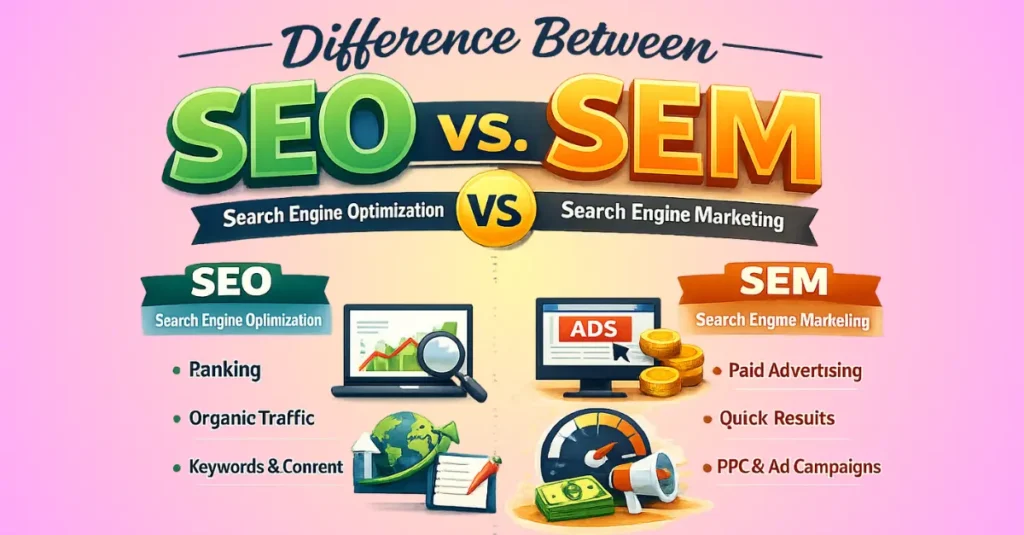
SEM vs SEO
Now let’s compare clearly.
SEO |
SEM |
|---|---|
|
Organic results |
Paid results |
|
Long-term strategy |
Instant traffic |
|
No direct cost per click |
Cost per click model |
|
Slower but sustainable |
Stops when budget stops |
Both have different purposes, smart businesses combine them.
Let’s simplify with a real example:
If someone searches for “best website development services in Hyderabad,” SEO helps your website rank organically because of optimized content and authority, and SEM helps your ad appear at the top because you paid for that keyword.
👉SEO builds digital assets.
👉SEM buys visibility.
👉SEO compounds.
👉SEM scales instantly.
The real growth strategy uses both strategically.
Closing Thoughts
The real question is not SEO or SEM.
What stage is your business in?
👉If you want long-term authority and sustainable traffic, invest in SEO.
👉If you want quick leads and immediate visibility, use SEM.
👉If you want market domination, combine both.
At our agency, we do not choose randomly.
We build customized strategies based on:
- Industry competition
- Business goals
- Budget
- Growth timeline
Because digital marketing is not about tools.
It is about results.
If you want a strategy built specifically for your business, the right time to start is now.