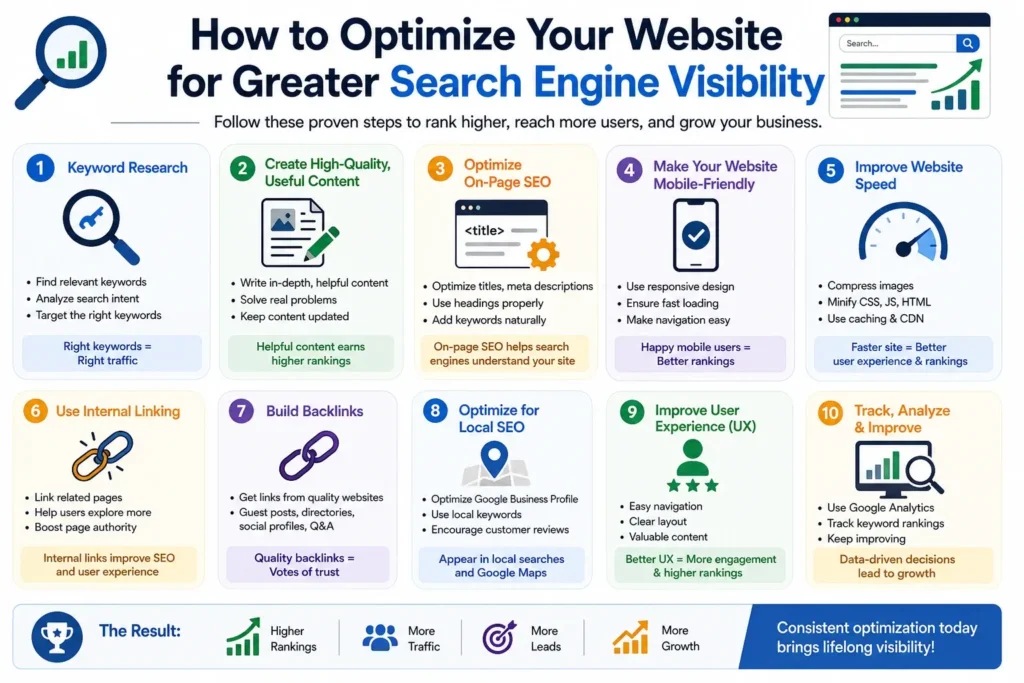
How to Optimize Your Website for Greater Search Engine Visibility
If your website is not visible on search engines, it is almost invisible to your customers.
In 2026, ranking is not about tricks.
It is about clarity, relevance, and consistency.
👉Search engines are smarter.
👉Competition is stronger.
👉And only optimized websites get attention.
If you want traffic that converts, you need to optimize your site the right way.
Let’s break it down step by step.
What “Search Engine Visibility” really means
Most people think search engine visibility simply means ranking on Google. But in reality, it goes much deeper than just appearing on the first page.
Search engine visibility is about being seen by the right people at the right time with the right intent.
Let me explain it in a simple way:
Showing up for the right keywords
It’s not about ranking for random or high-volume keywords; the real point is to rank for the terms that your potential customers are actually searching for.
For example, ranking for “website” is too broad. But ranking for “affordable website design for small businesses” brings in people who are already looking for your service.
Attracting the right audience
Traffic alone doesn’t matter if those visitors are not interested in what you offer. The goal is to bring people who are genuinely curious, ready to learn, or prepared to take action.
Right audience = higher chances of trust and engagement.
Getting clicks that turn into leads
Even if your website appears in search results, people must choose to click on it. That depends on how attractive your title, description, and overall presence look.
And after they click, your content should guide them toward taking action, like contacting you, signing up, or buying something.
Why it’s not just SEO alone
Achieving real visibility requires more than basic SEO techniques.
It’s a mix of:
- Smart SEO (so your site can be found)
- Valuable content (so users stay and trust you)
- Strong performance (fast loading, mobile-friendly, smooth experience)
When all these elements work together, your website doesn’t just get traffic… it builds real business opportunities.
Simply, search engine visibility is not about being seen by everyone. It’s about being seen by the right people who are ready to take action.
Start with Keyword Research
Before you create any content, you need to understand what people are actually searching for. That’s where keyword research comes in. It helps you connect your content with real user intent instead of guessing topics.
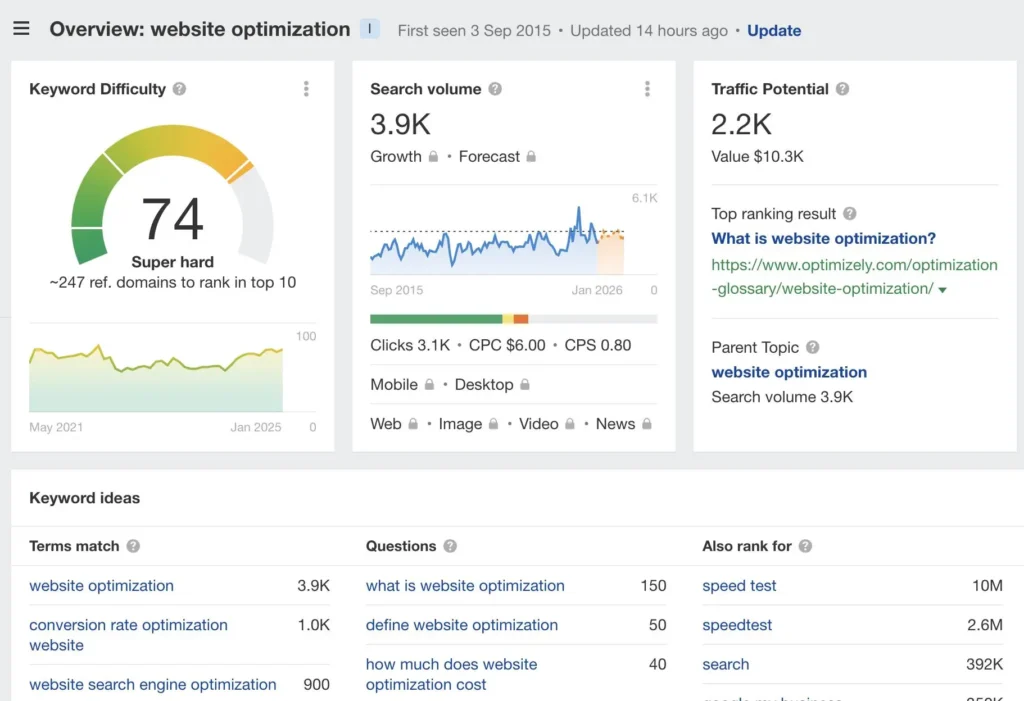
Use tools that show real data
Platforms like Ahrefs and Ubersuggest give you insights into search volume, competition, and keyword difficulty. These tools don’t just suggest keywords, they reveal opportunities your competitors might be missing.
What you should focus on
- High-intent keywords: These are searches where users are ready to take action. For example, “hire SEO expert” or “best website designer near me.” These bring real business potential, not just traffic.
- Long-tail keywords: These are more specific phrases with lower competition. They may have less search volume, but they attract highly targeted visitors who know exactly what they want.
- Problem-solving queries: People often search because they have a problem. If your content answers that problem clearly, you instantly build trust and authority.
Example that makes it clear
Instead of targeting a broad keyword like “SEO,” go for something more specific like “how to improve SEO for small business.”
The difference is simple:
- Broad keyword = high competition, unclear intent
- Specific keyword = lower competition, clear intent, better chances to rank
The real insight
Specific keywords don’t just bring traffic, they bring the right traffic. And when the right people find your content, your visibility naturally improves and turns into meaningful results.
Optimize on-page SEO
Once you’ve chosen the right keywords, the next step is making sure your content is structured in a way that search engines can easily understand and rank.
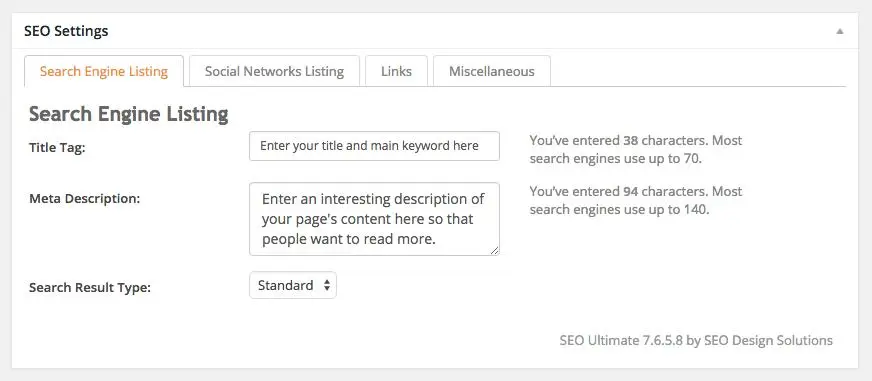
Think of on-page SEO as giving clear signals about what your page is all about.
Use smart SEO plugins
If you’re using WordPress, tools like Yoast SEO or Rank Math can guide you step by step. This plugins help you optimize content without needing deep technical knowledge.
Key elements you should focus on
Title Tags (Clear and keyword-focused)
Your title is the first thing both users and search engines notice. Keep it simple, relevant, and include your main keyword naturally.
Meta Descriptions (Make people want to click)
This is your chance to stand out in search results. Write a short, compelling summary that encourages users to click on your page.
Headings Structure (H1, H2, H3, H4)
Break your content into clear sections using headings. This improves readability and helps search engines understand the hierarchy of your content. You can see this structure in this article as well.
Keyword Placement (Keep It natural)
Use your keyword in important places like the title, headings, and introduction. But avoid overstuffing. Your content should always feel natural and easy to read.
Internal Linking (Connect your content)
Link to other relevant pages on your website. This helps search engines crawl your site better and keeps users engaged longer.
What is its real purpose?
On-page SEO is not about tricking algorithms. It’s about making your content so clear and well-structured that search engines can confidently understand it and show it to the right audience.
When your content is easy to understand, it becomes easier to rank.
Create high-quality, useful content
Search engines today are smarter than ever, and platforms like Google are focused on one thing above all else: helpful content that genuinely solves problems.
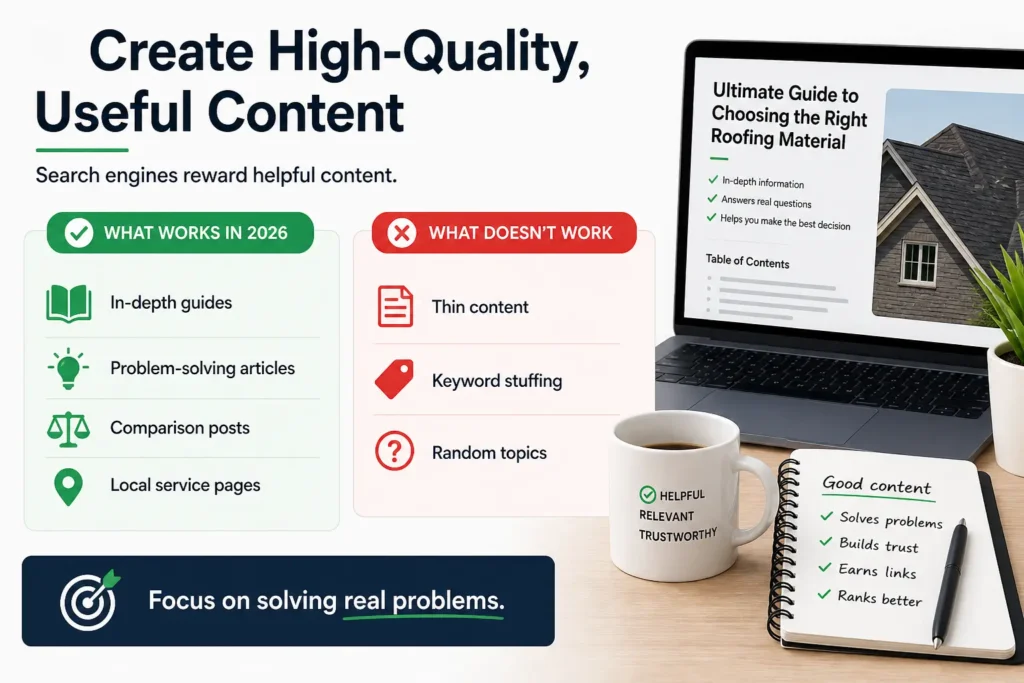
It’s no longer about publishing more content, but about publishing content that actually matters.
What Works in 2026
In-depth guides:
Detailed, well-structured guides that fully explain a topic perform extremely well. When someone lands on your page, they should feel like they don’t need to search anywhere else.
Problem-solving articles:
Content that answers real questions or fixes real issues builds trust quickly. If your article removes confusion or gives clarity, users stay longer and engage more.
Comparison posts:
People love clarity before making decisions. Comparisons like “A vs B” or “Which is better” help users choose and often lead to higher conversions.
Local service pages:
If you offer services, creating location-specific pages helps you reach people searching in your area. This is powerful for attracting high-intent, ready-to-convert visitors.
What doesn’t work anymore
Thin content:
Short, shallow articles with little value are ignored. Search engines can easily detect when content lacks depth.
Keyword stuffing:
Repeating keywords unnaturally doesn’t help, it actually harms your rankings and user experience.
Random, unfocused topics:
Publishing content without a clear direction confuses both users and search engines. Consistency and relevance are key.
The real focus should be on
Your content should aim to solve a specific problem better than anyone else. When your content becomes genuinely useful, everything else follows naturally, including traffic, engagement, and conversions.
All I am saying is that you should not create content just for ranking, but create content that is worthy of ranking.
Improve website speed
Website speed is not just a technical detail. It directly affects how people experience your site and how search engines like Google rank it.
If your website is slow, visitors leave before they even see your content. That sends a negative signal to search engines, which can lower your rankings.
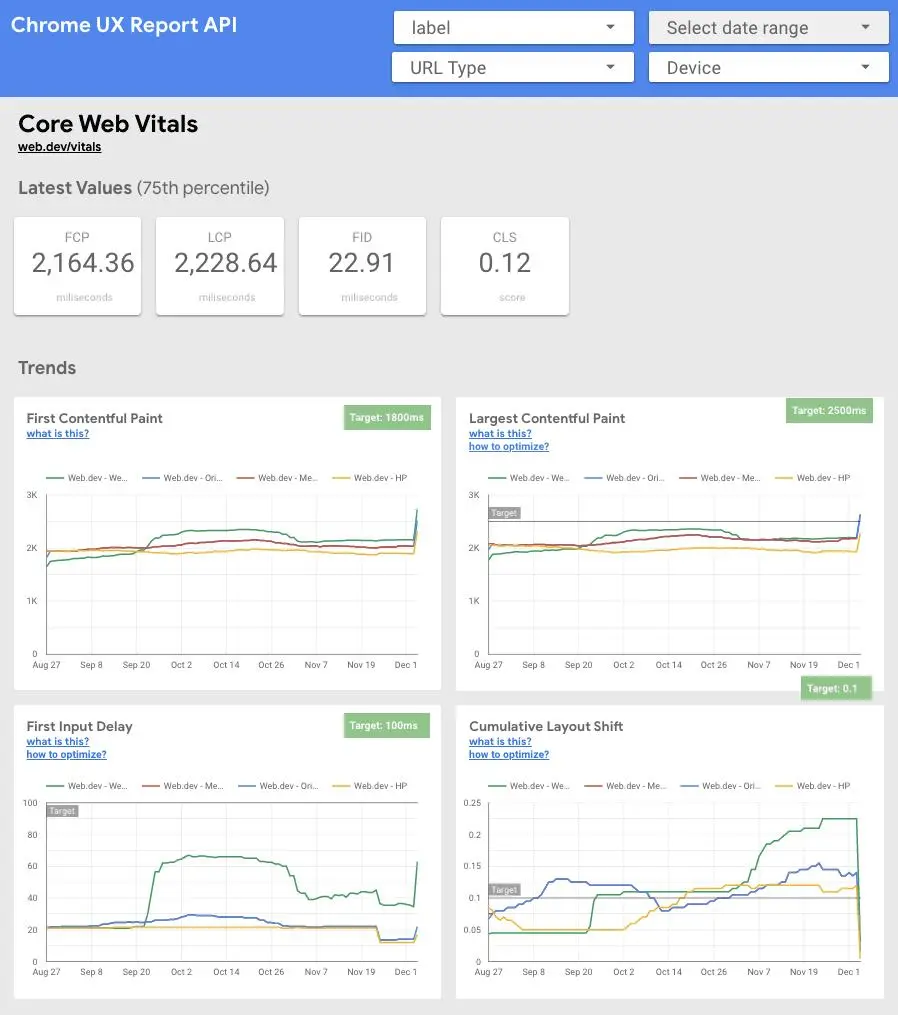
Analyze your website speed
You can test your site performance using tools like PageSpeed insights and GTmetrix. It shows what’s slowing your site down and gives clear suggestions to fix it.
Why speed really matters
A slow website leads to:
- Higher bounce rates (people leave quickly)
- Lower engagement (less time spent on your site)
- Fewer conversions (lost leads and sales)
On the other hand, a fast website creates a smooth experience, builds trust, and keeps users engaged.
How to fix and improve speed
Compress Images:
Large images slow down your site significantly. Use optimized formats and compression tools to reduce size without losing quality.
Use Caching:
Caching stores parts of your website so it loads faster for returning visitors. This reduces server load and improves overall performance.
Minimize Code:
Clean and reduce unnecessary CSS, JavaScript, and HTML. Less code means faster loading times.
Choose Fast Hosting:
Your hosting provider plays a big role in speed. A reliable, high-performance hosting service ensures your website loads quickly even during traffic spikes.
Real impact on the user
Speed is not just about rankings. It shapes how people feel when they visit your website.
A fast site feels professional, trustworthy, and easy to use. And when users enjoy the experience, they stay longer, explore more, and are more likely to take action.
Make your website mobile-friendly
Today, most people browse the internet on their phones, not desktops. Search engines like Google also prioritize mobile-first indexing, which means they mainly evaluate your mobile version to decide rankings.
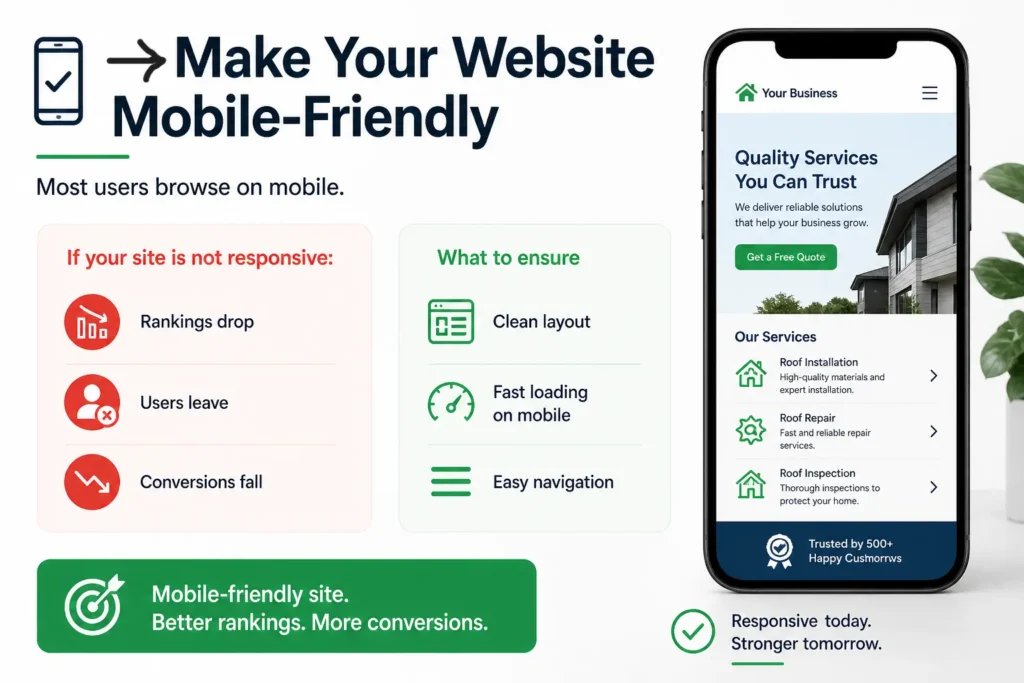
If your website is not optimized for mobile, the impact is immediate and noticeable.
- Rankings start to drop because your site doesn’t meet modern standards
- Users leave quickly due to poor experience
- Conversions decline because navigation feels frustrating
What you should ensure
Clean and Simple Layout:
On mobile, space is limited. Your design should be uncluttered, with clear sections and easy-to-read text. Avoid overcrowding elements that make the page feel messy.
Fast Loading on Mobile:
Mobile users expect speed. If your site takes too long to load, they won’t wait. Optimized images, lightweight design, and efficient coding make a huge difference here.
Easy Navigation:
Menus, buttons, and links should be easy to tap without zooming. A user should be able to find what they need within seconds without confusion.
Real insight
Mobile-friendliness is not just about fitting your website on a smaller screen. It’s about creating a smooth, effortless experience for users on the go.
When your site feels easy to use on mobile, visitors stay longer, trust your brand more, and are far more likely to take action.
Build topic authority
Publishing one great article is not enough anymore. Search engines like Google look for consistency and depth before they trust a website.
They don’t rank you just because you wrote one good post. But they rank you because you consistently prove expertise in a specific topic.
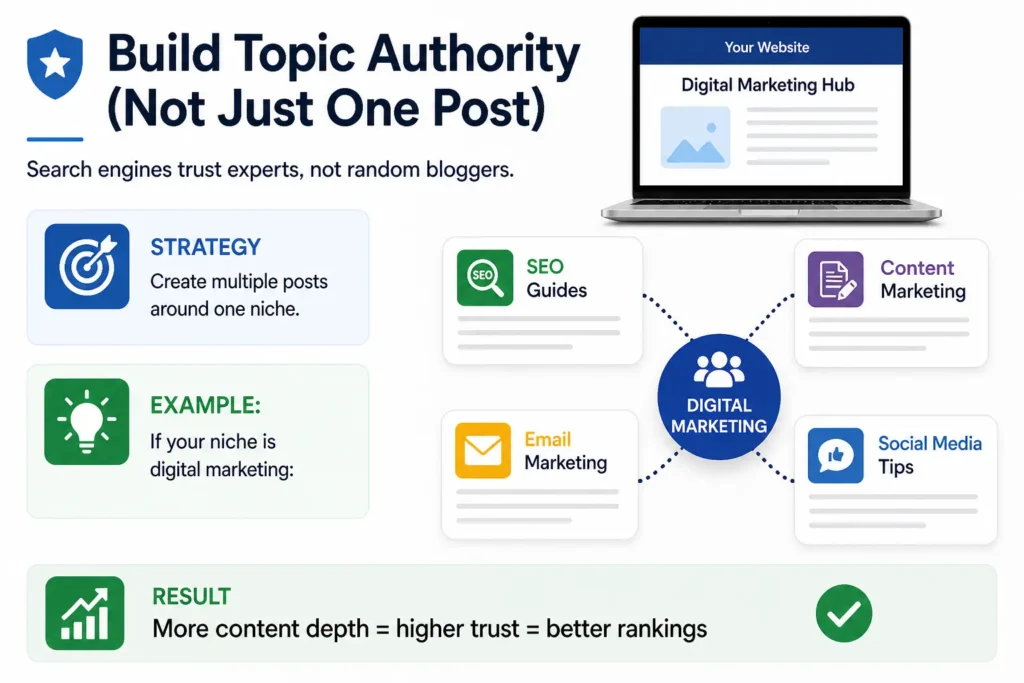
The real strategy
Instead of covering random topics, focus on one niche and build multiple pieces of content around it. This creates a strong signal that your website is a reliable source in that area.
Example to understand it better
If your niche is digital marketing, don’t stop at one article. Create a content ecosystem like:
- SEO guides (beginner to advanced)
- Content marketing strategies
- Email marketing tips and funnels
- Social media growth techniques
- Blogging and make money online
- Website designing and development
- Online startups
Each piece should connect with the others, forming a complete knowledge base.
Why this works
When you cover a topic from multiple angles:
- Your website gains depth and relevance
- Users spend more time exploring related content
- Search engines start recognizing you as an authority
The real result
More content depth leads to stronger trust, and stronger trust leads to better rankings.
Simply, don’t try to be everywhere. Focus on one area, go deep, and become the go-to source for that topic.
Use internal linking
Internal linking is one of the simplest yet most powerful ways to strengthen your website. It means connecting one page of your site to another in a logical and helpful way.
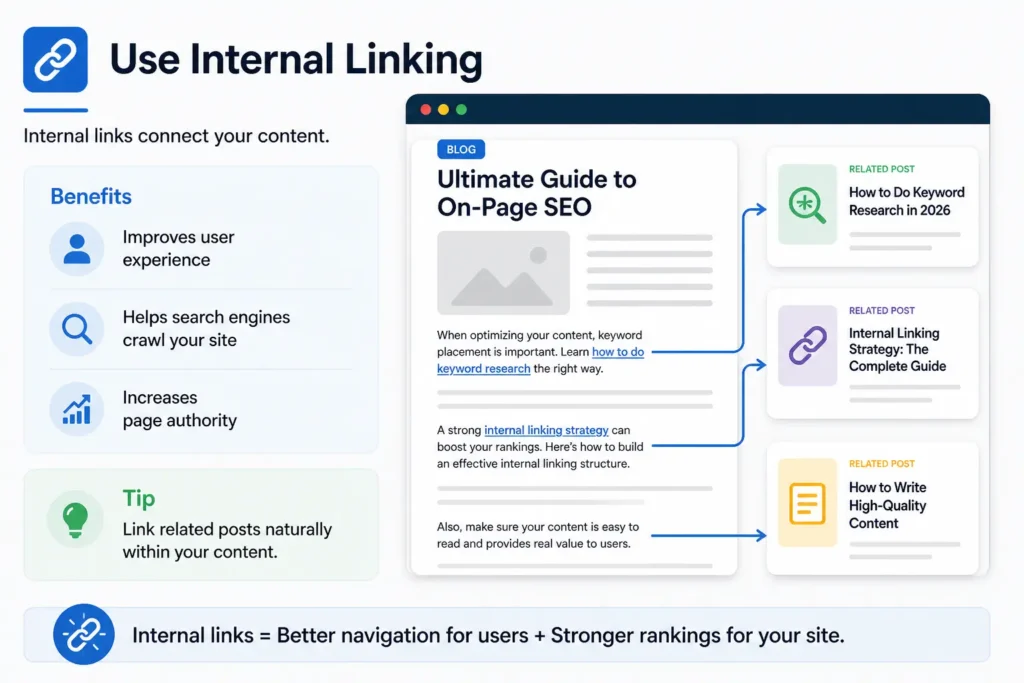
Think of it as guiding your visitors and search engines through your content smoothly.
Why internal linking matters
Improves User Experience:
When readers find links to related topics, they naturally explore more of your website. This keeps them engaged and helps them find exactly what they’re looking for without extra effort.
Helps Search Engines Crawl Your Site:
Search engines like Google use links to discover and understand your pages. A well-linked structure makes it easier for them to index your content properly.
Increases Page Authority:
When you link from one strong page to another, you pass value and relevance. This helps boost the visibility of important pages across your site.
Smart tip
Don’t just add links randomly. Link related posts naturally within your content where they actually add value.
For example, if you’re talking about SEO strategies, linking to a detailed guide on keyword research or on-page SEO makes perfect sense and improves the reader’s journey.
The real insight
Internal linking is not just about SEO. It’s about creating a connected experience where every page supports another.
When your content is well-connected, your website becomes easier to explore, easier to understand, and much stronger in search rankings.
Build backlinks
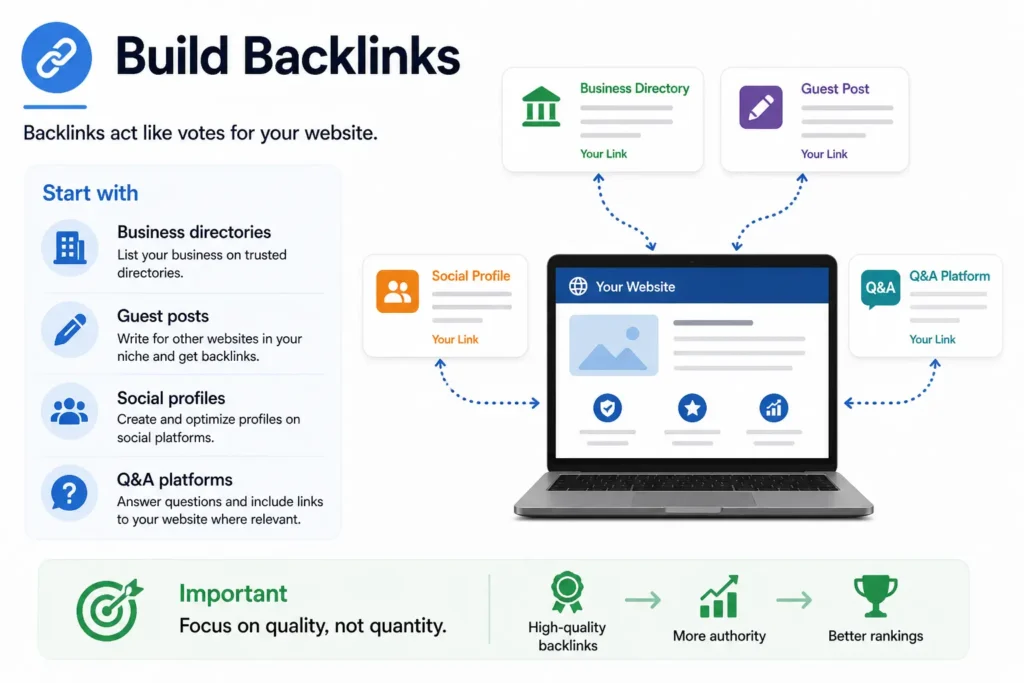
Backlinks are links from other websites pointing to your site. Search engines view these links as signals of trust and credibility.
In simple terms, when other websites link to you, it’s like they’re saying, “this content is valuable.”
Where to start
Business Directories:
List your website on trusted directories like Google Business Profile. This helps with both visibility and local SEO.
Guest Posts:
Write articles for other websites in your niche. You not only gain exposure to a new audience but also earn a high-quality backlink.
Social Profiles:
Create and optimize profiles on platforms like LinkedIn. Even though these links are often no-follow, they still build credibility and brand presence.
Q&A Platforms:
Answer questions on platforms like Reddit, and Quora. Provide genuine value and link back to your content where relevant.
What really matters
Not all backlinks are equal.
- A few high-quality, relevant backlinks are far more powerful
- Hundreds of low-quality or spammy links can actually harm your rankings
Backlinks are not just about numbers. They’re about trust, relevance, and authority.
When your website earns links from credible sources, search engines see you as reliable and worth ranking higher.
Optimize for local SEO
If your business serves a specific city or area, local SEO can bring highly targeted customers straight to you. Search engines like Google prioritize nearby results when users search for services “near me” or within a location.
That means your goal is simple: show up exactly when local customers are ready to take action.
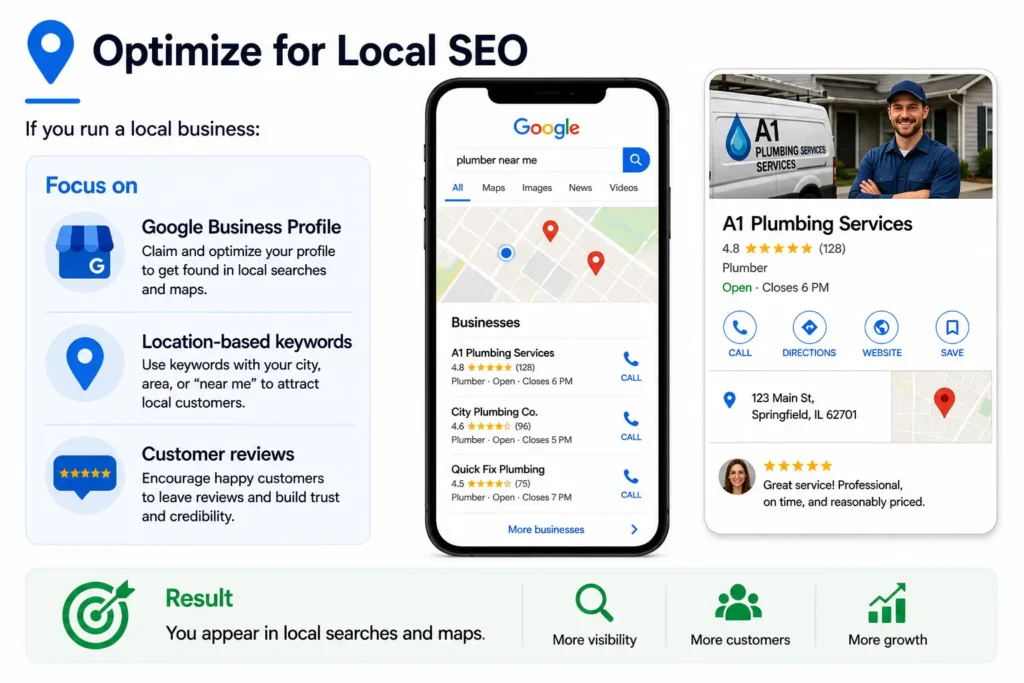
What you should focus on
Google Business Profile:
Create and optimize your listing on Google Business Profile. Add accurate details like your business name, address, phone number, website, and working hours. A well-optimized profile increases your chances of appearing in local map results.
Location-Based Keywords:
Use keywords that include your city or area.
For example, instead of “website design,” use “website design in Hyderabad” or your target location. This really helps search engines connect your services with local searches.
Customer Reviews:
Encourage satisfied clients to leave genuine reviews. Positive feedback builds trust and also improves your visibility in local rankings.
As a result, what you see:
When done right, local SEO helps your business appear in:
- Local search results
- Map listings
- “Near me” searches
This means you’re not just getting traffic, you’re getting people nearby who are ready to contact or visit you.
Simply, local SEO turns your online presence into a powerful tool for attracting real, local customers.
Track performance and improve
SEO is not a one-time task. It’s an ongoing process where you learn, adjust, and grow based on real data. Instead of guessing what’s working, you need to measure it.
Use the right tools
Tools like Google Search Console and Google Analytics give you clear insights into how your website is performing. They show what’s driving results and where you’re losing opportunities.
What you should track
Keyword Rankings:
See which keywords your website is ranking for and how those positions change over time. This helps you understand what content is gaining visibility.
Traffic Sources:
Find out where your visitors are coming from, whether it’s search engines, social media, or direct visits. This helps you focus on the channels that bring the best results.
User Behavior:
Analyze how users interact with your site. Which pages they visit, how long they stay, and where they drop off. This reveals what’s engaging and what needs improvement.
What to do next
Data alone is not enough; the real value comes from action.
- Improve the content that is already performing well
- Update or optimize pages that are underperforming
- Fix technical or usability issues that affect user experience
Real insight
Growth comes from continuous improvement. When you track the right metrics and make smart adjustments, your website becomes stronger over time.
In simple terms, don’t just create and leave it. Measure, learn, and keep improving.
The biggest SEO mistakes to avoid
- Ignoring keyword research
- Publishing low-quality content
- Slow website speed
- No internal linking
- Inconsistent posting
Avoiding mistakes is as important as applying strategies.
Simple SEO plan for beginners
If you’re starting today:
- Choose a niche
- Do keyword research
- Publish 1–2 posts per week
- Optimize each post
- Track results monthly
Stay consistent for 90 days. If you follow all the things I have mentioned here, you will definitely see results.
The real secret to search engine visibility
There is no shortcut.
Search engines reward:
- Useful content
- Fast websites
- Consistency
If you focus on these three, visibility follows.
Closing Thoughts
SEO in 2026 is not as complicated as it seems, but it does demand consistency and a clear approach.
You don’t have to master everything at once. What matters is starting with the fundamentals and improving them step by step. Small, consistent efforts over time create powerful results.
Search engines are no longer impressed by shortcuts or tricks. They reward websites that are genuinely helpful, well-structured, and focused on user experience.
So instead of chasing quick wins, focus on building a strong foundation:
- Create content that solves real problems
- Optimize your website for clarity and performance
- Continuously improve based on data and insights
In the end, the goal is simple. Build a website that people trust, enjoy, and find valuable.
Because when your website truly deserves to rank, rankings follow naturally.
READ MORE: Top Digital Marketing Strategies for Business Growth